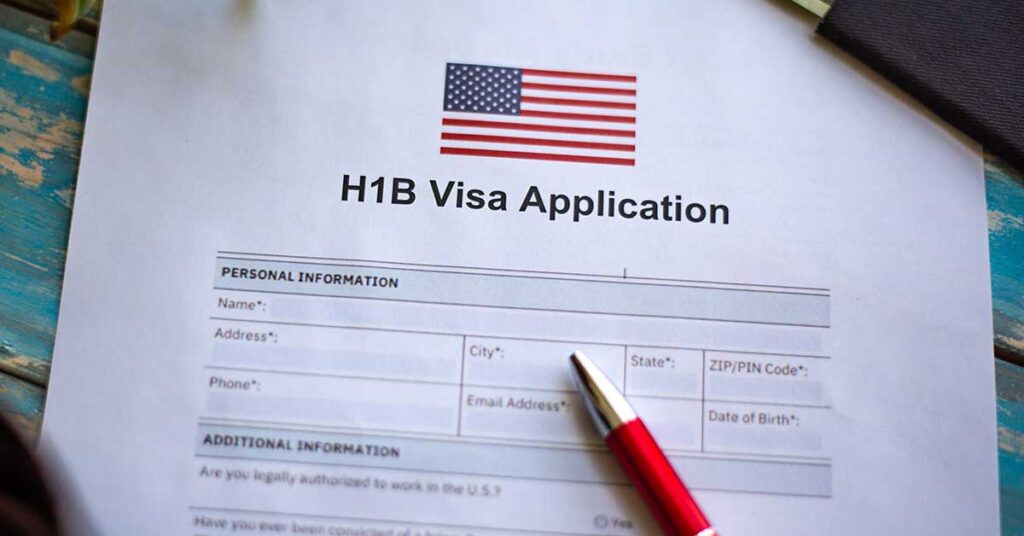
Recent changes to U.S. immigration policy are raising concerns among international medical graduates about their chances of building long-term careers in the United States. In September of 2025, the federal government announced a one-time $100,000 filing requirement for new H-1B petitions, leaving many IMGs to wonder if healthcare employers would be willing to sponsor or continue to sponsor the necessary visas. Fortunately, the new fees do not apply to the renewal of existing H-1B visas nor to a change of status for a J-1 visa holder currently training in the United States.
That said, in a new report from Jackson Physician Search, The New Physician Recruitment Reality: Current Trends and the Road Ahead, our recruitment leaders noted that healthcare leaders are showing a new hesitancy to hire non-citizens. However, the hesitancy doesn’t appear to be impacting hiring just yet. According to Jackson Physician Search 2025 data, the number of placements involving H-1B visas and J-1 visa waivers was consistent with prior years. So, while leaders may have concerns about changes to U.S. immigration policy, specifically H-1B visa fees, they are not ruling out hiring J-1 candidates.
Of course, this doesn’t mean the process will be easy. As Vice President of Recruitment at Jackson Physician Search, I’ve helped many international medical graduates secure their first post-residency positions in the United States. Finding an employer willing to sponsor a J-1 visa waiver can feel overwhelming, but understanding the timeline and logistics is absolutely critical for success. Keep reading to find out what you need to know.
Understanding the Conrad 30 Program
For most J-1 visa holders, the Conrad 30 program is the primary pathway to remaining in the United States after training. This federal program allocates 30 J-1 waiver slots to each state annually, allowing J-1 visa holders to work in medically underserved areas for a minimum of three years under an H-1B visa, rather than returning to their home country post-training, as the J-1 visa requires.
This benefits all parties involved: Underserved communities gain access to critically needed healthcare providers, while J-1 visa holders have the opportunity to build their careers in America immediately following their training. However, the limited number of waivers makes the program highly competitive, so timing isn’t just important — it’s everything.
The Critical J-1 Waiver Job Search Timeline: Start Earlier Than You Think
Physicians who will need a J-1 visa waiver must begin the job search earlier than their peers. This means starting at least 18 months before completing your training. I cannot emphasize this enough. Starting too late is the single biggest mistake I see J-1 physicians make, and it can derail your entire plan to stay in the United States.
With a few exceptions, J-1 visas require holders to return to their home countries within 30-60 days of completing training. So, J-1 visa holders must have both an employment contract and a waiver upon graduation. So when should you start? Working backwards, let’s break down the timeline.
9 months prior to completing residency (October of final training year)
To quickly transition from residency to employment, as your visa requires, you must apply for a J-1 waiver in the fall of your final year of residency. Most Conrad 30 application cycles open in October, with Texas and a few other states opening in September. The program will issue its decisions by the end of the year.
Of course, in order to apply, you must have a signed employment contract. So, you should aim to have a final contract from your employer by August first to ensure you have ample time to prepare your application for the state in which you will work.
12-14 months prior to completing residency (April-June of penultimate training year)
Let’s continue to work backwards towards the goal of having a signed contract by August first. You can expect to spend 2-3 months on the complete interview process and contract finalization, so you should aim to start interviewing with potential employers in April or May of your second-to-last year of training. This timeline accounts for site visits, due diligence, attorney review (critical to ensure the contract adheres to the Conrad 30 requirements), and the back-and-forth of contract negotiations. If you begin interviewing during this window, you should have a signed contract by August first.
18 months prior to completing residency (January of penultimate training year)
In order to start the interview process no later than May, you should begin your job search in earnest midway through your second-to-last year of residency. At this time, reach out to a trusted physician recruiter to learn about the current market and let them know what you are looking for in a job. Discuss your preferences for practice settings and location, but be clear that the most important criterion is that the employer is willing and able to sponsor a J-1 visa waiver. It’s even better if the employer has successfully done so in the past.
Starting in January gives you some flexibility to ease into the job search, monitoring physician job boards as you prepare your CV and cover letters. However, by early spring of your penultimate year, you should be actively applying and scheduling interviews for May and June.
In review, consider the following timeline:
- 18 months prior to completing residency program (January): Reach out to a physician recruiter for market guidance and to notify of interest
- 16 months prior (March): Begin submitting job applications and scheduling interviews
- 12-14 months prior (April-June): Interview with potential employers
- 11 months prior (July): Aim to finalize contract by August 1st
- 9 months prior (September-October): Submit Conrad 30 waiver application
- 6 months prior (December): Receive confirmation of waiver
Of course, even if you follow these steps precisely, not all waiver applications are approved. If you have done your research, you should have some idea about how competitive the program is in your state and have set your expectations accordingly. If your Conrad 30 waiver application is denied, there are a few other options. Primary care physicians have access to other federal and state programs, but specialists are more limited.
Geographic Flexibility: Your Secret Weapon
To increase your odds of receiving a Conrad 30 waiver, conduct research to identify states with the greatest needs. Details can typically be found on the website of each state’s health department. A physician recruiter can also provide insight. Some states consistently have unfilled Conrad 30 slots due to their rural nature or less desirable locations. If you’re willing to consider these locations, you’ll face significantly less competition. Geographic flexibility dramatically increases your chances of securing a waiver slot.
Specialty vs Primary Care
Your specialty significantly impacts your options. Specialty physicians are more heavily dependent on Conrad 30 slots than primary care physicians, who have several alternative pathways available.
Primary care physicians can also pursue:
- The U.S. Department of Health and Human Services offers waivers for primary care physicians working in locations with Health Professional Shortage Area (HPSA) scores of 7 or higher
- Regional programs like the Delta Regional Authority or Appalachian Regional Commission (typically rural locations)
- Federally Qualified Health Centers (FQHCs), which have unlimited J-1 slots
Some of these programs make exceptions for specialists if they have determined the need is great enough. Conduct research to identify areas of opportunity for your specialty.
Contract and Legal Considerations
Before signing anything, invest in an immigration attorney to review your contract — not an employment attorney. Immigration law expertise is crucial here, as employers must demonstrate they’ve unsuccessfully recruited non-visa candidates, and your attorney needs to ensure all immigration requirements are properly addressed.
Important contract restrictions to understand:
- No signing bonuses can be paid during your training period
- Three-year commitment with very limited transfer options
- Transfers require egregious circumstances, and new employers may be reluctant to hire candidates seeking to transfer
Choose your employer and location carefully, because the three-year commitment is serious.
Your Action Plan
It’s never too early to begin your research. Visit state health department websites to understand specific processes and requirements. Build relationships with physician recruiters who specialize in J-1 placements. Be geographically flexible. And most importantly, begin your search at least 18 months before you plan to start working.
The J-1 waiver process requires patience, strategy, and meticulous timing. But with proper planning and realistic expectations, you can successfully navigate this pathway and build a rewarding career serving communities that need you most.
For more information on the Conrad State 30 J-1 Visa Waiver Program, details are available through the U.S. Citizenship and Immigration Services website. Additional information is available from the Rural Health Information Hub.
To connect with a physician recruiter who has experience working with international medical school graduates, reach out to the Jackson Physician Search team today.
About Tonya Hamlin
With over 20 years of experience in the healthcare industry, Tonya Hamlin has a relentless passion for connecting physicians and advanced practice providers with health systems and medical groups. Prior to joining Jackson Physician Search, Tonya served as a physician recruiter for an integrated delivery system. Her unique vantage point allows her to identify the best candidates and offer valuable market insights to her clients, ensuring strategic decisions that drive results. As Regional Vice President of Recruiting for Jackson Physician Search’s Dallas Division, she excels in understanding the distinct needs of each client and delivering customized recruitment strategies.